



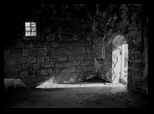

Mental province
About the serie
The work encompasses several photo sessions in Kiryat Gat, the city where I
was living for 3 years from '93 to '96.
I am approaching a theme of degradation which occures with in forgotten israeli development towns like Kiryat Gat and people living there.
The photographs express the feelings of fading out, degradation, vanishing of signs of human activities alongside abundance of desert nature
It is a moment before death.
The corp of a baby bull lays in the center of the city, in once beauteful place, which for decades was acting amphitheater, now destroyed. This was my favourite spot to spend the evenings out. In spring 2007 during two and half months I had visited Kiryat Gat and all that time the body had been laying and distructing there.
When I started to make pictures, a security man approached to me to know what was the purpose of taking pictures. During conversation with him I figured out that the amphethater was destroyed since the city municipality decided to build the new one instead. Unfortunately it was able only to ruin the existing.
Then the nearby junction was reconstructed and the sand from there was moved into ampheteater, creating a hill and possibly engraving remains of the bull under it.
"Kiryat Gat (Hebrew: קִרְיַת גַּת, Arabic: كريات جات) , is a city in the Southern District of Israel. Modern Kiryat Gat was established in 1955 as a development town by 18 families from Morocco. According to Israel Central Bureau of Statistics, the city's population in 2005 was 47,600. Since the mass immigration of Soviet Jews, approximately one third of the inhabitants hail from the former Soviet Union.
After the Polgat factory was closed in '90 Kiryat Gat has one of Israel's highest unemployment rates"(Wikipedia)
As a teenager and new repatriant I used to live in several development towns and have witnessed how influences people this atmosphere of 'no future'. Only hard phisical labour on factory is available if any. High unempoyment level reveals employers' unpleasant sides and lets them to be greedy and ignorent towards workers.
This situation makes people ignorent, dull and creates a desire to escape. For this reason in such places many teens start using hard drugs and alcohol.
People usually work on factories. The jobs are phisically exhausting and monotoneus. Low wages forge people to work more and then one has no power to do anything but to eat and go sleep early to prepare for the next day. But even if he liked the city has nothing to offer. No cultural event ever happens here, there is no theater, cinema or anything. The library is very poorly equipped. I have seen how strong men were broken there.
In '93 before starting my army duty I've been exploring the employment possibilities of Kiryat Gat.
First I've started to work on the candles factory. The owner was typical Polish man. In '54, when the factory was built, the most exhausting parts of the process were automated. With the time machines one by one were removed and by the year '93 the machines were turned off permanently, because the owner made observation that machine's operator had to wait anyway while it was working. So the process was "optimized". Every minute the worker had to push down some 10 kg of paraphine, wait and pull up it up. The electricity was saved and workers were kept in a good phisical condition. Thank you, Mr.Z!
Then I've been working as a general worker on Sugat factory. Once I was substituting someone on the packing line(conveyer). The job included several simple movements: fill the plastic pack, pick it up(100kg) and put into container. The tricky part was to do it quickly. By the end of the day my skin on hands burned out. On the next day I came with gloves and finished them during one day. I calculated then that the average amount to move during the shift was about 80 tonn. It was one of the most phisically demanding and monotoneous job on factory. The guy who worked there permanently was 55 years old man with Ph.D. The old man hated me because he was afraid that being younger and stronger I could take his job from him. This understanding pissed me off and made me to decide that should leave the town to get out from this lack of perspective, from the atmosphere of jelousy, mental dirt and anxiety.
I am approaching a theme of degradation which occures with in forgotten israeli development towns like Kiryat Gat and people living there.
The photographs express the feelings of fading out, degradation, vanishing of signs of human activities alongside abundance of desert nature
It is a moment before death.
The corp of a baby bull lays in the center of the city, in once beauteful place, which for decades was acting amphitheater, now destroyed. This was my favourite spot to spend the evenings out. In spring 2007 during two and half months I had visited Kiryat Gat and all that time the body had been laying and distructing there.
When I started to make pictures, a security man approached to me to know what was the purpose of taking pictures. During conversation with him I figured out that the amphethater was destroyed since the city municipality decided to build the new one instead. Unfortunately it was able only to ruin the existing.
Then the nearby junction was reconstructed and the sand from there was moved into ampheteater, creating a hill and possibly engraving remains of the bull under it.
Social background
As a teenager and new repatriant I used to live in several development towns and have witnessed how influences people this atmosphere of 'no future'. Only hard phisical labour on factory is available if any. High unempoyment level reveals employers' unpleasant sides and lets them to be greedy and ignorent towards workers.
This situation makes people ignorent, dull and creates a desire to escape. For this reason in such places many teens start using hard drugs and alcohol.
People usually work on factories. The jobs are phisically exhausting and monotoneus. Low wages forge people to work more and then one has no power to do anything but to eat and go sleep early to prepare for the next day. But even if he liked the city has nothing to offer. No cultural event ever happens here, there is no theater, cinema or anything. The library is very poorly equipped. I have seen how strong men were broken there.
Personal stories
In '93 before starting my army duty I've been exploring the employment possibilities of Kiryat Gat.
First I've started to work on the candles factory. The owner was typical Polish man. In '54, when the factory was built, the most exhausting parts of the process were automated. With the time machines one by one were removed and by the year '93 the machines were turned off permanently, because the owner made observation that machine's operator had to wait anyway while it was working. So the process was "optimized". Every minute the worker had to push down some 10 kg of paraphine, wait and pull up it up. The electricity was saved and workers were kept in a good phisical condition. Thank you, Mr.Z!
Then I've been working as a general worker on Sugat factory. Once I was substituting someone on the packing line(conveyer). The job included several simple movements: fill the plastic pack, pick it up(100kg) and put into container. The tricky part was to do it quickly. By the end of the day my skin on hands burned out. On the next day I came with gloves and finished them during one day. I calculated then that the average amount to move during the shift was about 80 tonn. It was one of the most phisically demanding and monotoneous job on factory. The guy who worked there permanently was 55 years old man with Ph.D. The old man hated me because he was afraid that being younger and stronger I could take his job from him. This understanding pissed me off and made me to decide that should leave the town to get out from this lack of perspective, from the atmosphere of jelousy, mental dirt and anxiety.
